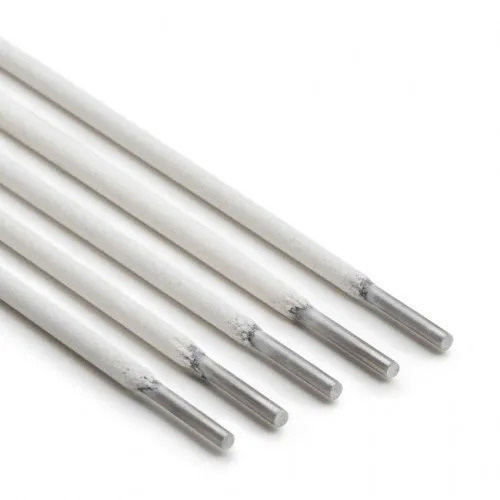
The EutecTrode 670 electrode is often specified under the UNS designation UNS S30908 and aligns with the ASTM Grade A—commonly grouped in the E309-type class of electrodes because of its chromium and nickel enriched composition. It is recognized in the welding industry as a “universal electrode”, ideal for joining stainless steels, carbon steels, or steels whose precise metallurgy is not known. Because of this versatility, engineers and welders often refer to it by its universal standard classification when specifying it in drawings or repair documents. In operation, its weld metal offers a tensile strength in excess of 95,000 psi (about 655 MPa) and delivers reliable ductility and impact strength even in mixed metallurgy joints.
When preparing to weld with EutecTrode 670, cleaning the base metal surface to remove oxides and scale is critical. Preheat and interpass temperatures should be tailored to the known or estimated base metal—unknown steels may use a moderate 200–300 °F preheat. The short‐arc, stringer bead technique yields the best performance, and weaving beyond three times the electrode diameter should be avoided. The combination of low dilution, stable arc, and a robust alloy core makes it particularly useful in maintenance, repair, overlay, and dissimilar-steel joining tasks across industries such as power generation, chemical processing, marine, and heavy fabrication.
Because EutecTrode 670 Welding Electrodes exhibit strong weldability, they reduce the risk of cracking, even in transition welds between stainless and mild steels. Their superior metallurgical compatibility, combined with strong corrosion and scaling resistance, makes them a go-to in critical service. By choosing EutecTrode 670 from Metals And Welding Specialities, you get a product supported by technical know-how, consistent quality, and responsive support. Whether you’re tackling repair welds, butt joints, overlays, or weld reinforcement, this electrode offers a dependable solution for challenging steel welding tasks.
Choosing EutecTrode 670 from Metals And Welding Specialities ensures you get quality assurance, batch traceability, and support in qualification. Our technical team can guide you in matching rod diameter, current settings, and overlay strategies to your equipment. Whether you aim to refurbish worn components or build new wear surfaces, EutecTrode 670 provides a balanced solution of abrasion resistance, weldability, and long life.
Specification EutecTrode 670 Welding Electrodes
Specification
Description
Product Name
EutecTrode 670
Product Type
Coated Electrode
Alloy Type
High Chromium Iron Alloy
Welding Process
SMAW (Shielded Metal Arc Welding)
Coating Type
Basic/Low Hydrogen
Typical Hardness (As Deposited)
55 – 60 HRC
Typical Hardness (After Work Hardening)
Up to 65 HRC
Typical Applications
Crusher hammers, bucket teeth, dredge parts, agricultural tools, and earth-moving equipment
Base Materials
Carbon steels, low alloy steels, and manganese steels
Current Type
DC+ (Reverse Polarity) or AC
Operating Temperature
Up to 450°C
Deposition Rate
High
Resistance
Excellent resistance to severe abrasion and moderate impact
Typical Weld Metal Composition
Cr 28–32%, C 3.5–4.5%, Fe Balance
Electrode Sizes (mm)
3.2, 4.0, 5.0
Typical Current Range (A)
3.2 mm: 90–130 A, 4.0 mm: 130–180 A, 5.0 mm: 180–230 A
Packaging
Available in 5 kg and 20 kg cartons
Standards
AWS A5.13: E FeCr-A (Equivalent)
Manufacturer
Eutectic Castolin
EutecTrode 670 Welding Electrodes Parameters
Parameter
Value / Range
Tensile Strength (as deposited)
≈ 97,000 psi (≈ 670 kg/mm²)
Yield Strength
≈ 65,000 psi (≈ 448 N/mm²)
Elongation (1 = 5d)
≥ 25 %
Hardness (as deposited)
HRB 85
Maximum Service Temperature (steady state)
1,800 °F (≈ 982 °C)
Current & Polarity
DCEP (+) and AC
Recommended Amperage by Electrode Diameter
3/32″ (2.4 mm)
50–70 A
1/8″ (3.2 mm)
70–110 A
5/32″ (4.0 mm)
110–150 A
Arc Technique / Best Practice
Short, non-contact arc; stringer beads or 2× to 3× weave; do not weave > 3× electrode diameter